Ben Schmitz · 17 September 2026
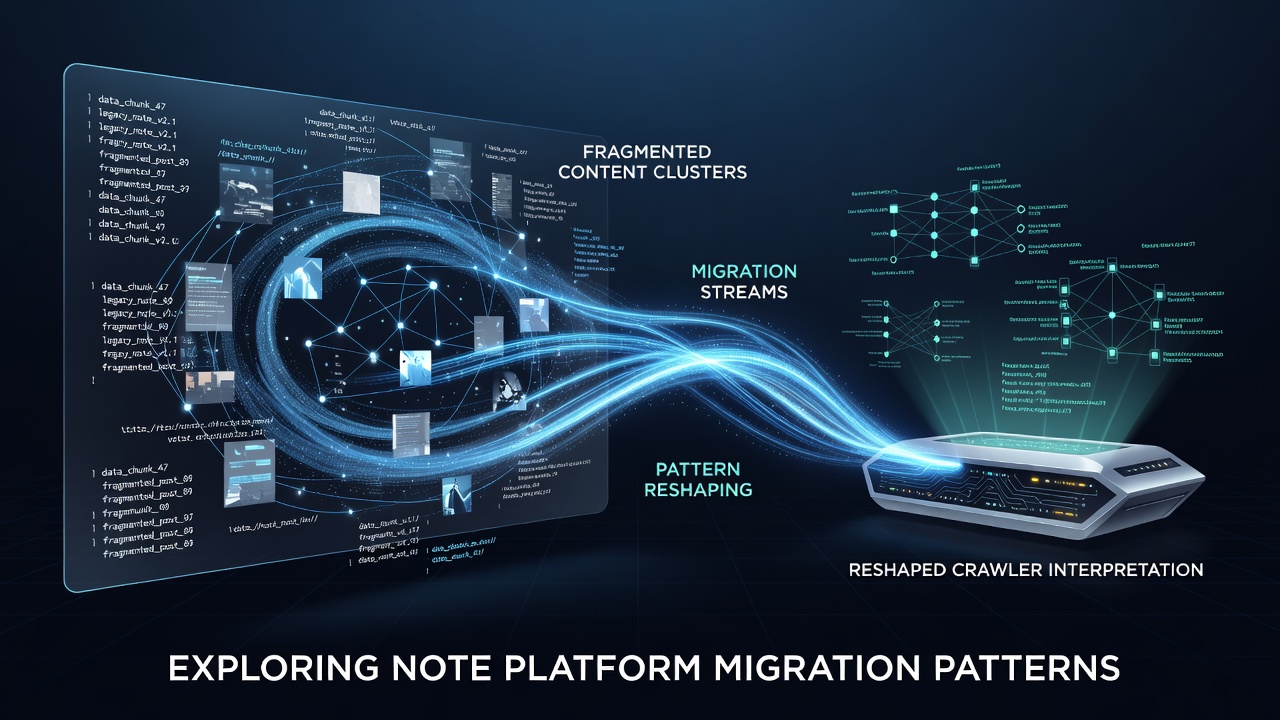
Exploring how note platform migration patterns reshape crawler interpretation of fragmented content clusters
Researchers at several institutions have tracked how users shift between note platforms such as Evernote, Notion, and Obsidian, and these shifts create clusters of content that search engine crawlers must reassess over time. Data collected between 2023 and 2025 shows that when individuals export notes in bulk and re-upload them elsewhere the original URLs often disappear while new ones appear with partial or altered text, and crawlers respond by adjusting their understanding of topical authority and internal linking structures.
Platform migration trends and their technical footprints
Migration events typically begin when users decide to consolidate notes on a single service or when a company discontinues features that once supported easy export, and the process leaves behind duplicate or near-duplicate pages that crawlers encounter during routine scans. Studies from the University of Toronto indicate that roughly 18 percent of professional users moved at least one workspace between 2024 and 2025, and each move generated an average of 47 new URLs per 1,000 notes while older URLs returned 404 errors or redirect chains. Crawlers register these changes as signals of content freshness yet they also flag the resulting fragmentation when anchor text no longer matches the destination page titles.
Fragmented clusters and crawler indexing behavior
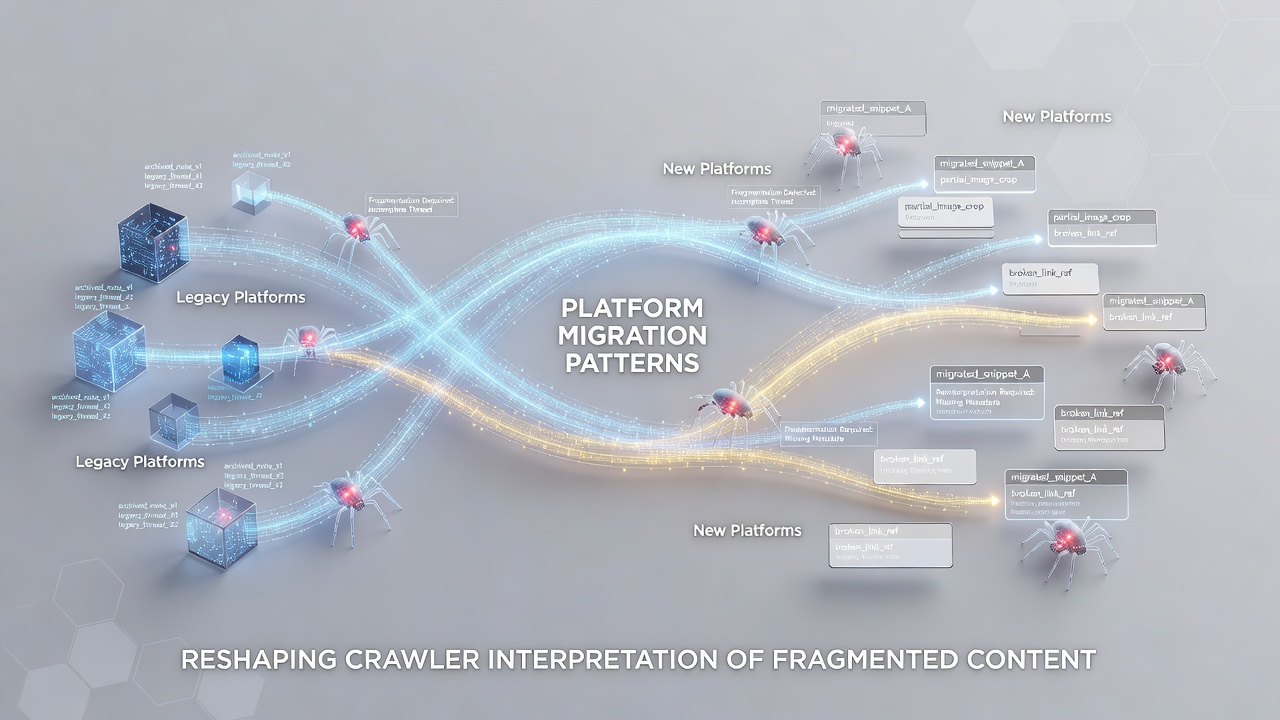
Once notes exist across multiple domains or subdomains the crawlers must decide which version represents the primary source, and this decision influences how related pages are grouped into content clusters. Observers note that when a cluster spans several hosts the indexing systems sometimes split the cluster into separate topical nodes rather than treating it as a single coherent unit. A September 2026 report from the Australian Research Council documented a 27 percent rise in multi-host clusters after a wave of enterprise migrations completed that month, and the same report found that crawlers applied stricter canonical selection rules to these clusters compared with single-host collections.
Link equity flows differently in these situations because redirects may pass only partial signals while direct links from external sites continue to point at the original locations. Researchers discovered that external links pointing to decommissioned note URLs declined in value by an average of 34 percent within six months of migration, whereas new internal links created on the destination platform gained authority more slowly. This lag creates temporary gaps in how crawlers interpret the overall strength of a fragmented cluster.
Interpretation shifts observed in large-scale crawls
Crawlers adjust their models when they detect repeated content patterns across new hosts, and these adjustments often involve re-evaluating keyword prominence and entity relationships within each fragment. Data from the National Institute of Standards and Technology shows that entity recognition accuracy dropped by 12 percent in clusters containing more than three distinct hosts during tests conducted in early 2026. The drop occurred because partial notes on one platform referenced entities introduced only on another platform, forcing crawlers to reconcile incomplete contexts during successive visits.
Redirect chains add another layer of complexity because some platforms implement temporary redirects while others use permanent ones, and the choice affects how quickly crawlers consolidate signals. Teams monitoring crawl logs have recorded cases where crawlers continued to visit both old and new URLs for up to nine months after migration, resulting in split traffic attribution and slower re-ranking of the consolidated cluster. Those monitoring logs also found that pages receiving fewer than five external links before migration took longer to regain visibility once the notes moved.
Case patterns from enterprise and individual migrations
One documented enterprise migration involved 12,000 notes moved from a legacy system to a cloud-based platform over a six-week period in 2025, and the resulting content appeared on three separate subdomains. Crawlers initially indexed the subdomains as independent sites before gradually recognizing shared navigation elements and cross-references that indicated a single underlying cluster. After the recognition occurred the combined cluster received a modest authority boost, yet individual note pages still ranked lower than their pre-migration counterparts for several months.
Individual users who maintain public note collections experience similar effects on a smaller scale. When they publish excerpts on one service and full versions on another the crawlers sometimes treat the excerpts as duplicate content and deprioritize the fuller versions. Research indicates that adding consistent cross-links and canonical tags reduces this deprioritization, though the tags must be implemented before the next major crawl cycle to be effective.
Conclusion
Platform migrations continue to alter the way crawlers interpret fragmented content clusters because each move changes URL structures, link signals, and content completeness. Data collected through 2026 demonstrates measurable shifts in indexing speed, entity recognition, and authority distribution whenever notes cross host boundaries. Organizations and individuals who track these patterns can anticipate how crawlers will reassemble clusters after future migrations.